Palagruža Island: Croatia’s Most Remote & Wild Sailing Destination
Far beyond the popular routes of Hvar, Brač, and Vis lies a place most visitors to Croatia never see.
About 42 nautical miles from the mainland, almost halfway between Croatia and Italy, sits Palagruža — a small rocky island rising alone from the open Adriatic Sea.
There are no towns.
No marinas.
No beach bars.
No crowds.
Only lighthouse keepers, seabirds, clear water, and silence.
For sailors, reaching Palagruža is not just another stop.
It’s an expedition.
Where Is Palagruža?
Palagruža is the most remote inhabited point of Croatia. It lies southwest of Vis and closer to the Italian coast than to Split. On clear days you feel completely surrounded by open sea in every direction.
Because of its position, the island has always been important for navigation. Ships traveling between the eastern and western Adriatic passed here for centuries, which is why a lighthouse was built on the highest point of the island.
Today it still functions and is staffed year-round.
The Lighthouse
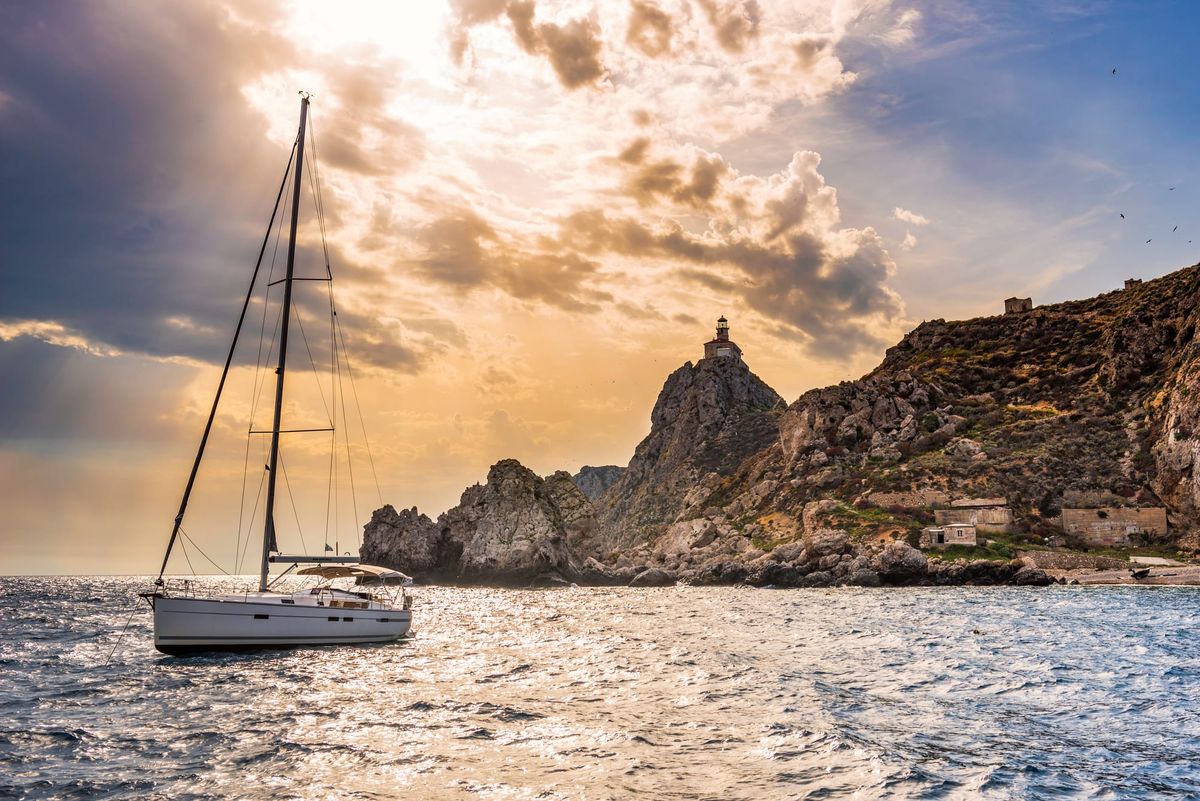
At 90 meters above sea level stands the Palagruža Lighthouse, built in 1875 during the Austro-Hungarian period. It is one of the most isolated lighthouses in the Mediterranean.
The keepers live on the island for weeks at a time. Supplies arrive only occasionally by boat, and strong winds can delay visits for days.
Some sailors arrange an overnight stay in the lighthouse apartments — a rare experience: no traffic, no artificial lights, and a night sky filled completely with stars.
At sunset, you understand why this place fascinates navigators, fishermen, and sailors.
Sailing to Palagruža
This is not a normal charter stop.
From Vis or Komiža the sail takes 6–9 hours depending on wind and sea state. The route crosses fully open water with no shelter along the way. Weather planning is essential.
Typical considerations:
- You need stable forecast conditions
- The Maestral wind strengthens in the afternoon
- Waves can build significantly offshore
- There is no marina or fuel station
Because of this, many charter itineraries never include Palagruža. It is usually visited only by experienced sailors or with a professional skipper.
However, the journey itself becomes part of the adventure. Dolphins are often spotted on this crossing because the sea is deeper and less trafficked.
Anchoring & Landing
Palagruža has only a few possible anchorages. The most commonly used is Velo Žalo on the southern side — a wide pebble beach with exceptionally clear water.
Anchoring depends heavily on wind direction. If conditions change, boats must sometimes leave and sail overnight to a safer island. This unpredictability is part of the experience.
There are:
- no protected marina berths
- no water supply
- no shops
You bring everything with you.
A steep path leads from the beach to the lighthouse. The walk takes about 20–25 minutes and rewards you with one of the widest views in the Adriatic Sea.
Swimming & Nature
The water around Palagruža is among the clearest in Croatia.
Because it is far from mainland rivers and coastal development, visibility underwater can exceed 30 meters. The seabed drops quickly into deep blue water, making it excellent for snorkeling and diving.
You will notice:
- almost no boat noise
- abundant fish
- complete quiet at night
It feels more like being on an oceanic island than in the Mediterranean.
Why Sailors Dream About It
Most charter guests remember Hvar for nightlife or Vis for history.
But sailors remember Palagruža.
Not because it is luxurious — it is the opposite. It represents freedom, distance, and the original purpose of sailing: reaching places inaccessible by normal travel.
You wake up surrounded only by horizon.
No ferries.
No music.
No schedules.
Just sea and sky.
Is It for Everyone?
Not really.
Palagruža is not a typical holiday stop. If you want restaurants, nightlife, or easy mooring, the central Dalmatian islands are a better choice.
But if you want to experience the Adriatic the way sailors historically did — navigating by weather, planning passages, and anchoring in true isolation — few places in Europe compare.
For many experienced guests, visiting Palagruža becomes the highlight of an entire sailing week in Croatia.